


| Allicdata Part #: | 568-6690-ND |
| Manufacturer Part#: |
LPC1778FBD208,551 |
| Price: | $ 0.00 |
| Product Category: | Integrated Circuits (ICs) |
| Manufacturer: | NXP USA Inc |
| Short Description: | IC MCU 32BIT 512KB FLASH 208LQFPARM® Cortex®-M3 LP... |
| More Detail: | N/A |
| DataSheet: |  LPC1778FBD208,551 Datasheet/PDF LPC1778FBD208,551 Datasheet/PDF |
| Quantity: | 3710 |
| Series: | LPC17xx |
| Packaging: | Tray |
| Part Status: | Active |
| Applications: | -- |
| Core Processor: | ARM® Cortex®-M3 |
| Core Size: | 32-Bit |
| Speed: | 120MHz |
| Controller Series: | -- |
| Connectivity: | CANbus, EBI/EMI, Ethernet, I²C, Microwire, Memory Card, SPI, SSI, SSP, UART/USART, USB OTG |
| Peripherals: | Brown-out Detect/Reset, DMA, I²S, Motor Control PWM, POR, PWM, WDT |
| Interface: | -- |
| Number of I/O: | 165 |
| Program Memory Size: | 512KB (512K x 8) |
| Voltage - Supply: | 2.4V ~ 3.6V |
| Program Memory Type: | FLASH |
| EEPROM Size: | 4K x 8 |
| Mounting Type: | Surface Mount |
| RAM Size: | 96K x 8 |
| Voltage - Supply (Vcc/Vdd): | 2.4 V ~ 3.6 V |
| Data Converters: | A/D 8x12b, D/A 1x10b |
| Oscillator Type: | Internal |
| Operating Temperature: | -40°C ~ 85°C (TA) |
| Package / Case: | 208-LQFP |
| Supplier Device Package: | 208-LQFP (28x28) |
| Base Part Number: | LPC1778 |
Due to market price fluctuations,if you need to purchase or consult the price.You can contact us or emial to us: sales@allicdata.com
1. Description
The LPC1778FBD208 is an ARM Cortex-M3 based microcontroller for embedded applications requiring a high level of integration and low power dissipation. The ARM Cortex-M3 is a next generation core that offers better performance than the ARM7 at the same clock rate and other system enhancements such as modernized debug features and a higher level of support block integration. The ARM Cortex-M3 CPU incorporates a 3-stage pipeline and has a Harvard architecture with separate local instruction and data buses, as well as a third bus with slightly lower performance for peripherals. The ARM Cortex-M3 CPU also includes an internal prefetch unit that supports speculative branches. The LPC178x/7x adds a specialized flash memory accelerator to accomplish optimal performance when executing code from flash. The LPC178x/7x operates at up to 120 MHz CPU frequency. The peripheral complement of the LPC178x/7x includes up to 512 kB of flash program memory, up to 96 kB of SRAM data memory, up to 4032 byte of EEPROM data memory, External Memory Controller (EMC), LCD (LPC178x only), Ethernet, USB Device/Host/OTG, a General Purpose DMA controller, five UARTs, three SSP controllers, three I2C-bus interfaces, a Quadrature Encoder Interface, four general purpose timers, two general purpose PWMs with six outputs each and one motor control PWM, an ultra-low power RTC with separate battery supply and event recorder, a windowed watchdog timer, a CRC calculation engine, up to 165 general purpose I/O pins, and more. The analog peripherals include one eight-channel 12-bit ADC and a 10-bit DAC. The pinout of LPC178x/7x is intended to allow pin function compatibility with the LPC24xx and LPC23xx.
2. Features
1. Functional replacement for the LPC23xx and LPC24xx family devices.
2. System:
- ARM Cortex-M3 processor, running at frequencies of up to 120 MHz. A Memory Protection Unit (MPU) supporting eight regions is included.
- ARM Cortex-M3 built-in Nested Vectored Interrupt Controller (NVIC).
- Multilayer AHB matrix interconnect provides a separate bus for each AHB master. AHB masters include the CPU, USB, Ethernet, and the General Purpose DMA controller. This interconnect provides communication with no arbitration delays unless two masters attempt to access the same slave at the same time.
- Split APB bus allows for higher throughput with fewer stalls between the CPU and DMA. A single level of write buffering allows the CPU to continue without waiting for completion of APB writes if the APB was not already busy.
- Cortex-M3 system tick timer, including an external clock input option.
- Standard JTAG test/debug interface as well as Serial Wire Debug and Serial WireTrace Port options.
- Embedded Trace Macrocell (ETM) module supports real-time trace.
- Boundary scan for simplified board testing.
- Non-maskable Interrupt (NMI) input.
3. Memory:
- Up to 512 kB on-chip flash program memory with In-System Programming (ISP) and In-Application Programming (IAP) capabilities. The combination of an enhanced flash memory accelerator and location of the flash memory on the CPU local code/data bus provides high code performance from flash.
- Up to 96 kB on-chip SRAM includes: 64 kB of main SRAM on the CPU with local code/data bus for high-performance CPU access. Two 16 kB peripheral SRAM blocks with separate access paths for higher throughput. These SRAM blocks may be used for DMA memory as well as for general purpose instruction and data storage.
- Up to 4032 byte on-chip EEPROM.
4. LCD controller, supporting both Super-Twisted Nematic (STN) and Thin-Film Transistors (TFT) displays.
- Dedicated DMA controller.
- Selectable display resolution (up to 1024 768 pixels).
- Supports up to 24-bit true-color mode.
5. External Memory Controller (EMC) provides support for asynchronous static memory devices such as RAM, ROM and flash, as well as dynamic memories such as single data rate SDRAM with an SDRAM clock of up to 80 MHz.
6. Eight channel General Purpose DMA controller (GPDMA) on the AHB multilayer matrix that can be used with the SSP, I2S, UART, CRC engine, Analog-to-Digital and Digital-to-Analog converter peripherals, timer match signals, GPIO, and formemory-to-memory transfers.
7. Serial interfaces:
- Ethernet MAC with MII/RMII interface and associated DMA controller. These functions reside on an independent AHB.
- USB 2.0 full-speed dual-port device/host/OTG controller with on-chip PHY and associated DMA controller.
- Five UARTs with fractional baud rate generation, internal FIFO, DMA support, and RS-485/EIA-485 support. One UART (UART1) has full modem control I/O, and one UART (USART4) supports IrDA, synchronous mode, and a smart card mode conforming to ISO7816-3.
- Three SSP controllers with FIFO and multi-protocol capabilities. The SSP controllers can be used with the GPDMA.
- Three enhanced I2C-bus interfaces, one with a true open-drain output supporting the full I2C-bus specification and Fast-mode Plus with data rates of 1 Mbit/s, two with standard port pins. Enhancements include multiple address recognition and monitor mode.
- I2S-bus (Inter-IC Sound) interface for digital audio input or output. It can be used with the GPDMA.
- CAN controller with two channels.
8. Digital peripherals:
- SD/MMC memory card interface.
- Up to 165 General Purpose I/O (GPIO) pins depending on the packaging with configurable pull-up/down resistors, open-drain mode, and repeater mode. All GPIOs are located on an AHB bus for fast access and support Cortex-M3 bit-banding. GPIOs can be accessed by the General Purpose DMA Controller. Any pin of ports 0 and 2 can be used to generate an interrupt.
- Two external interrupt inputs configurable as edge/level sensitive. All pins on port 0 and port 2 can be used as edge sensitive interrupt sources.
- Four general purpose timers/counters with a total of eight capture inputs and ten compare outputs. Each timer block has an external count input. Specific timer events can be selected to generate DMA requests.
- Quadrature encoder interface that can monitor one external quadrature encoder.
- Two standard PWM/timer blocks with external count input option.
- One motor control PWM with support for three-phase motor control.
- Real-Time Clock (RTC) with a separate power domain. The RTC is clocked by a dedicated RTC oscillator. The RTC block includes 20 bytes of battery-powered backup registers, allowing system status to be stored when the rest of the chip is powered off. Battery power can be supplied from a standard 3 V lithium button cell. The RTC will continue working when the battery voltage drops to as low as 2.1 V. An RTC interrupt can wake up the CPU from any reduced power mode.
- Event Recorder tat can capture the clock value when an event occurs on any of three inputs. The event identification and the time it occurred are stored in registers. The Event Recorder is located in the RTC power domain and can therefore operate as long as there is RTC power.
- Windowed Watchdog Timer (WWDT). Windowed operation, dedicated internal oscillator, watchdog warning interrupt, and safety features.
- CRC Engine block can calculate a CRC on supplied data using one of three standard polynomials. The CRC engine can be used in conjunction with the DMA controller to generate a CRC without CPU involvement in the data transfer.
9. Analog peripherals:
- 12-bit Analog-to-Digital Converter (ADC) with input multiplexing among eight pins, conversion rates up to 400 kHz, and multiple result registers. The 12-bit ADC can be used with the GPDMA controller.
- 10-bit Digital-to-Analog Converter (DAC) with dedicated conversion timer and GPDMA support.
10. Power control:
- Four reduced power modes: Sleep, Deep-sleep, Power-down, and Deep power-down.
- The Wake-up Interrupt Controller (WIC) allows the CPU to automatically wake up from any priority interrupt that can occur while the clocks are stopped in Deep-sleep, Power-down, and Deep power-down modes.
- Processor wake-up from Power-down mode via any interrupt able to operate during Power-down mode (includes external interrupts, RTC interrupt, PORT0/2 pin interrupt, and NMI).
- Brownout detect with separate threshold for interrupt and forced reset.
- On-chip Power-On Reset (POR).
11. Clock generation:
- Clock output function that can reflect the main oscillator clock, IRC clock, RTC clock, CPU clock, USB clock, or the watchdog timer clock.
- On-chip crystal oscillator with an operating range of 1 MHz to 25 MHz.
- 12 MHz Internal RC oscillator (IRC) trimmed to 1% accuracy that can optionally be used as a system clock.
- An on-chip PLL allows CPU operation up to the maximum CPU rate without the need for a high-frequency crystal. May be run from the main oscillator or the internal RC oscillator.
- A second, dedicated PLL may be used for USB interface in order to allow added flexibility for the Main PLL settings.
12. Versatile pin function selection feature allows many possibilities for using on-chip peripheral functions.
13. Unique device serial number for identification purposes.
14. Single 3.3 V power supply (2.4 V to 3.6 V). Temperature range of -40 °C to 85 °C.
15. Available as LQFP208, TFBGA208, TFBGA180, and LQFP144 package.
3. Applications
1. Communications:
- Point-of-sale terminals, web servers, multi-protocol bridges
2. Industrial/Medical:
- Automation controllers, application control, robotics control, HVAC, PLC, inverters, circuit breakers, medical scanning, security monitoring, motor drive, video intercom
3. Consumer/Appliance:
- Audio, MP3 decoders, alarm systems, displays, printers, scanners, small appliances, fitness equipment
4. Automotive:
- After-market, car alarms, GPS/fleet monitors
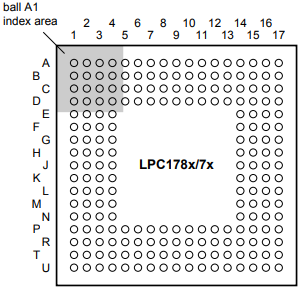
4. Pin configuration
5. Pin description
Unless otherwise specified, the I/O pins on LPC178x/7x can withstand 5V and have input hysteresis. The crystal pins, power pins, and reference voltage pins are not 5 V withstand voltage. In addition, when the pins are selected as ADC inputs, they are no longer 5 V Tolerance, the input voltage must be limited to the ADC positive reference voltage Pin (VREFP). All port pins Pn[m] are multiplexed, multiplexed functions Correspond to the order defined by the FUNC bit of the IOCON register until the highest Function number used. Each port pin can support up to 8 alternate functions. The reserved IOCON register FUNC value is marked as "R" in the pin configuration table.
6. Functional description
1. Architectural overview
The ARM Cortex-M3 includes three AHB-Lite buses: the system bus, the I-code bus, and the D-code bus. The I-code and D-code core buses are faster than the system bus and are used similarly to Tightly Coupled Memory (TCM) interfaces: one bus dedicated for instruction fetch (I-code) and one bus for data access (D-code). The use of two core buses allows for simultaneous operations if concurrent operations target different devices. The LPC178x/7x use a multi-layer AHB matrix to connect the ARM Cortex-M3 buses and other bus masters to peripherals in a flexible manner that optimizes performance by allowing peripherals that are on different slaves ports of the matrix to be accessed simultaneously by different bus masters.
2. ARM Cortex-M3 processor
The ARM Cortex-M3 is a general purpose, 32-bit microprocessor, which offers high performance and very low power consumption. The ARM Cortex-M3 offers many new features, including a Thumb-2 instruction set, low interrupt latency, hardware division, hardware single-cycle multiply, interruptable/continuable multiple load and store instructions, automatic state save and restore for interrupts, tightly integrated interrupt controller with wake-up interrupt controller, and multiple core buses capable of simultaneous accesses. Pipeline techniques are employed so that all parts of the processing and memory systems can operate continuously. Typically, while one instruction is being executed, its successor is being decoded, and a third instruction is being fetched from memory. The ARM Cortex-M3 processor is described in detail in the Cortex-M3 Technical Reference Manual that can be found on official ARM website.
3. On-chip flash program memory
The LPC178x/7x contain up to 512 kB of on-chip flash program memory. A new two-port flash accelerator maximizes performance for use with the two fast AHB-Lite buses.
4. EEPROM
The LPC178x/7x contains up to 4032 byte of on-chip byte-erasable and byte-programmable EEPROM data memory.
5. On-chip SRAM
The LPC178x/7x contain a total of up to 96 kB on-chip static RAM data memory. This includes the main 64 kB SRAM, accessible by the CPU and DMA controller on a higher-speed bus, and up to two additional 16 kB each SRAM blocks situated on a separate slave port on the AHB multilayer matrix. This architecture allows CPU and DMA accesses to be spread over three separate RAMs that can be accessed simultaneously.
6. Memory Protection Unit (MPU)
The LPC178x/7x have a Memory Protection Unit (MPU) which can be used to improve the reliability of an embedded system by protecting critical data within the user application. The MPU allows separating processing tasks by disallowing access to each other's data, disabling access to memory regions, allowing memory regions to be defined as read-only and detecting unexpected memory accesses that could potentially break the system. The MPU separates the memory into distinct regions and implements protection by preventing disallowed accesses. The MPU supports up to eight regions each of which can be divided into eight subregions. Accesses to memory locations that are not defined in the MPU regions, or not permitted by the region setting, will cause the Memory Management Fault exception to take place.
| Part Number | Manufacturer | Price | Quantity | Description |
|---|
| LPC1342FBD48,118 | NXP USA Inc | 1.41 $ | 1000 | IC MCU 32BIT 16KB FLASH 4... |
| LPC1765FBD100,551 | NXP USA Inc | 6.5 $ | 12027 | IC MCU 32BIT 256KB FLASH ... |
| LPC1225FBD64/301,1 | NXP USA Inc | 2.93 $ | 513 | IC MCU 32BIT 64KB FLASH 6... |
| LPC1112FHN33/202,5 | NXP USA Inc | 1.72 $ | 779 | IC MCU 32BIT 16KB FLASH 3... |
| LPC1114FHN33/202,5 | NXP USA Inc | 2.04 $ | 487 | IC MCU 32BIT 32KB FLASH 3... |
| LPC1113FHN33/301,5 | NXP USA Inc | 1.33 $ | 1000 | IC MCU 32BIT 24KB FLASH 3... |
| LPC1342FHN33,518 | NXP USA Inc | 1.34 $ | 1000 | IC MCU 32BIT 16KB FLASH 3... |
| LPC1902-9D | Bel Power So... | 569.5 $ | 1000 | AC-DC CONVERTERAC DC Conv... |
| LPC1768FET100,551 | NXP USA Inc | 7.8 $ | 3630 | IC MCU 32BIT 512KB FLASH ... |
| LPC1114FHN33/333,5 | NXP USA Inc | 2.3 $ | 1281 | IC MCU 32BIT 56KB FLASH 3... |
| LPC1114FHN33/302:5 | NXP USA Inc | 1.93 $ | 4946 | IC MCU 32BIT 32KB FLASH 3... |
| LPC1346FBD48,151 | NXP USA Inc | 3.82 $ | 247 | IC MCU 32BIT 48KB FLASH 4... |
| LPC1112FHN33/102,5 | NXP USA Inc | 1.61 $ | 314 | IC MCU 32BIT 16KB FLASH 3... |
| LPC11U12FHN33/201, | NXP USA Inc | 1.33 $ | 1000 | IC MCU 32BIT 16KB FLASH 3... |
| LPC1111FHN33/203,5 | NXP USA Inc | 1.51 $ | 282 | IC MCU 32BIT 8KB FLASH 33... |
| LPC1756FBD80,551 | NXP USA Inc | 5.88 $ | 2146 | IC MCU 32BIT 256KB FLASH ... |
| LPC1114FHI33/303,5 | NXP USA Inc | 1.99 $ | 425 | IC MCU 32BIT 32KB FLASH 3... |
| LPC18S37JET100E | NXP USA Inc | 8.64 $ | 240 | IC MCU 32BIT 1MB FLASH 10... |
| LPC1112JHN33/203E | NXP USA Inc | 1.2 $ | 1000 | IC MCU 32BIT 16KB FLASH 3... |
| LPC11H37FBD64/401, | NXP USA Inc | 2.88 $ | 1000 | IC MCU 32BIT ARM 64LQFPIC... |
| LPC18S57JET256E | NXP USA Inc | 10.0 $ | 13 | IC MCU 32BIT 1MB FLASH 25... |
| LPC1548JBD64QL | NXP USA Inc | 3.56 $ | 1000 | IC MCU 32BIT 128KB FLASH ... |
| LPC11U35FHI33/501, | NXP USA Inc | 3.12 $ | 6123 | IC MCU 32BIT 64KB FLASH 3... |
| LPC1778FET180,551 | NXP USA Inc | 8.23 $ | 1299 | IC MCU 32BIT 512KB FLASH ... |
| LPC1111JHN33/203E | NXP USA Inc | 1.57 $ | 260 | IC MCU 32BIT 8KB FLASH 33... |
| LPC1113JHN33/203E | NXP USA Inc | 1.29 $ | 1000 | IC MCU 32BIT 24KB FLASH 3... |
| LPC1778FBD144,551 | NXP USA Inc | -- | 5970 | IC MCU 32BIT 512KB FLASH ... |
| LPC1224FBD48/101,1 | NXP USA Inc | -- | 1331 | IC MCU 32BIT 32KB FLASH 4... |
| LPC1114JHI33/303E | NXP USA Inc | 2.05 $ | 0 | IC MCU 32BIT 32KB FLASH 3... |
| LPC11E36FBD64/501E | NXP USA Inc | 3.47 $ | 160 | IC MCU 32BIT 96KB FLASH 6... |
| LPC1774FBD208,551 | NXP USA Inc | 7.75 $ | 107 | IC MCU 32BIT 128KB FLASH ... |
| LPC1114LVFHN24/103 | NXP USA Inc | 1.25 $ | 1000 | IC MCU 32BIT 32KB FLASH 2... |
| LPC1823JBD144E | NXP USA Inc | 6.63 $ | 1000 | IC MCU 32BIT 512KB FLASH ... |
| LPC1114FHN33/203,5 | NXP USA Inc | 2.04 $ | 255 | IC MCU 32BIT 32KB FLASH 3... |
| LPC1752FBD80,551 | NXP USA Inc | 4.94 $ | 1864 | IC MCU 32BIT 64KB FLASH 8... |
| LPC1778FBD208,551 | NXP USA Inc | -- | 3710 | IC MCU 32BIT 512KB FLASH ... |
| LPC18S37JBD144E | NXP USA Inc | 8.86 $ | 60 | IC MCU 32BIT 1MB FLASH 14... |
| LPC1101LVUKZ | NXP USA Inc | 1.06 $ | 1000 | IC MCU 32BIT 32KB FLASH 2... |
| LPC1224FBD64/121,1 | NXP USA Inc | 3.4 $ | 160 | IC MCU 32BIT 48KB FLASH 6... |
| LPC11U37HFBD64/4QL | NXP USA Inc | 3.88 $ | 106 | IC MCU 32BIT 128KB FLASH ... |
AVR series Microcontroller IC 8-Bit 16MH...
AVR series Microcontroller, 8-bit Microc...
IC MCU 32BIT 64KB FLASH 48LQFPSTM32G071C...
GD32F407VET6. The frequency is up to 108...
GD32F103RBT6 is fully compatible with ST...
The processor frequency can reach 168MHz...